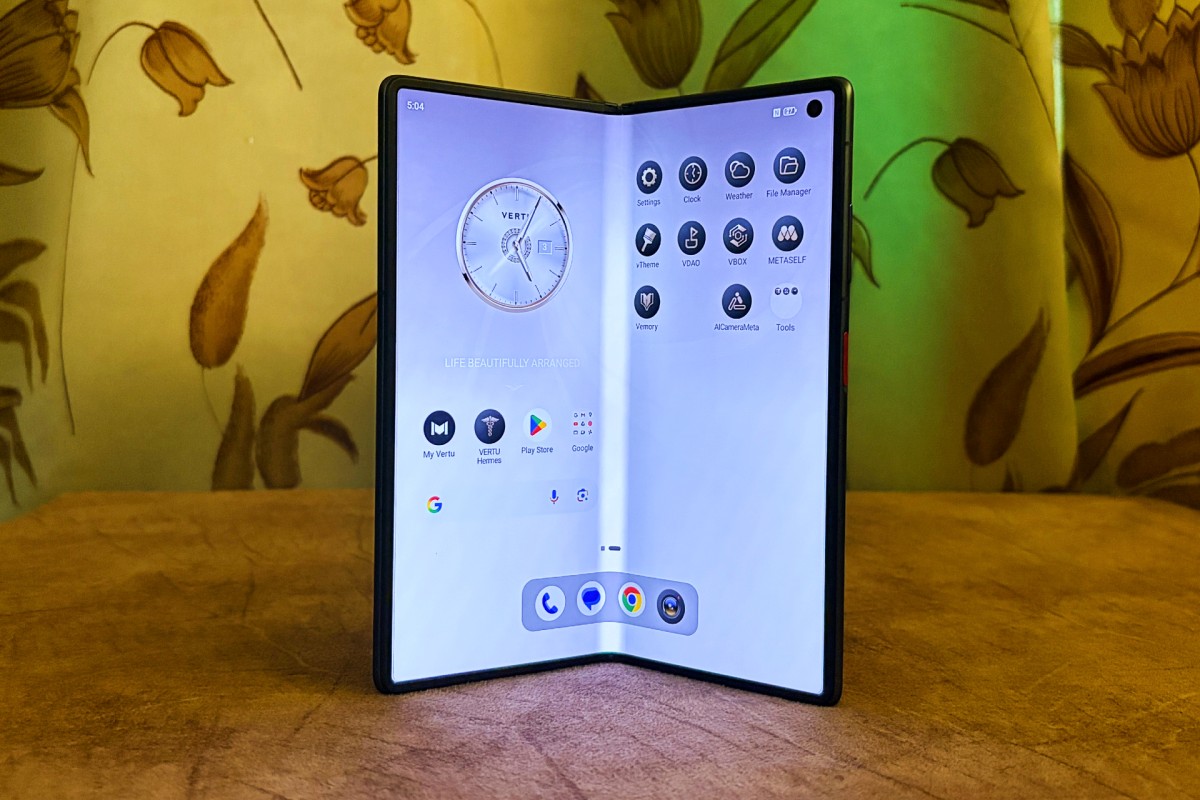
Luxury phones used to mean diamond-encrusted casings. Or maybe just a really good concierge service. Now, they mean artificial intelligence. Vertu, the British marque known for charging six figures for titanium and leather handsets, is leaning hard into that new narrative. Their latest play? The Alphafold. A foldable device wrapped in calfskin, targeting CEOs who apparently have too much money and not enough time to manage their own schedules.
The pitch is simple. Buy this $6,880 brick, and Hermes Agent—a bespoke AI assistant—will handle your busy life. No more manually clicking through apps. Hermes will read the contracts, book the flights, and generally act as a digital butler. But does it actually work for the working executive, or is it just another overpriced gadget trying to justify its existence? I spent a few days with the device, swapping out benchmark tests for actual business workflows to see if the luxury tax is worth it.
Зміст
Hardware: Expensive Feel, Familiar Bones
Let’s get the physical experience out of the way. The Alphafold starts at $6,880. You get a review unit wrapped in genuine calfskin. It’s heavy. Really heavy. At 264 grams, it sits significantly heavier than Samsung’s Galaxy Z Fold 7 (215 grams). Is it unwieldy? Not quite. But that extra weight adds up during long calls.
Vertu also took the time to design packaging that feels like jewelry. Oversized box. Drawers. A leather sleeve. It’s theater. And if you’re paying $6,880 for a phone, theater matters.
Here is the awkward truth, though: the hardware isn’t new. Underneath that premium skin, the Alphafold bears striking similarities to the ZTE Nubia Fold ($1,100). Same hinge. Same dimensions. Same speaker and microphone placements. Even the software occasionally shows ZTE identifiers. Vertu confirms they partnered with ZTE for the hardware platform and engineering. Vertu handles the materials, software, QC, and service. ZTE… didn’t respond to TechCrunch.
This isn’t a new strategy for Vertu. Their 2023 MetaVertu was also based on ZTE hardware. The point is: you aren’t paying for the engineering innovation. You’re paying for the brand, the materials, and the promise of what comes next.
Hermes Agent vs. Google Gemini
The real product here isn’t the phone. It’s the AI. Vertu calls it Hermes Agent. It’s built on the open-source Hermes project and is designed to execute multi-step workflows, not just answer prompts. Most phone assistants wait for you to ask. Hermes tries to do things for you.
I tested it against the Galaxy Z Fold 7 running Gemini. The results were messy.
The Airport Scenario
I simulated a rushed executive morning. I was leaving for the airport, running 20 minutes late. I asked Hermes to:
1. Message a contact that I was delayed.
2. Navigate to the airport.
3. Enable Do Not Disturb.
4. Remind me to call the hotel in 14 minutes (since I was asking at 2:32 a.m.).
Hermes sent the message. It enabled DND. It opened Google Maps. It also set the reminder for 9:08 p.m.
Wait. 9:08 p.m.? I asked for a reminder 15 minutes after 2:32 a.m. Hermes completely failed to grasp the timing logic. It also didn’t automatically start navigation, just opened the app.
I ran the same flow on the Samsung. Gemini asked follow-up questions. Which airport? Google Tasks or Samsung Reminder? It forced me to clarify. Once I did, it set the correct time and handled the logic properly.
Hermes acted autonomously. It completed more steps but got the core logic wrong. Gemini acted conservatively. It asked for input but delivered accurate results. Which is better for a CEO? If you value speed, Hermes. If you value accuracy, Samsung.
Planning Business Travel
Next, I asked Hermes to plan a trip from Mumbai to Pune. Morning flight. Hotel recommendation. Add to calendar.
Hermes replied that no direct morning flights existed. It offered a “Contact Butler” button to hand the job off to a human. It also created a calendar event for July 7 instead of July 18-19. Wrong dates. Incomplete workflow.
Gemini did the same flight check, found no direct morning options, but then suggested alternative travel times and continued planning without handing it off to a human.
Hermes wants to be an agent. Gemini wants to be a helpful assistant. Hermes often overreaches and fails. Gemini plays it safe.
The Memory Problem
I tested document analysis on both. Hermes was faster at automating actions across apps. But its memory is brittle.
I uploaded a financial spreadsheet. Hermes summarized the Q2 figures correctly. Days later, I tried to follow up on the same chat. Hermes said it couldn’t access local files. “Please upload the Sales spreadsheet again.” It had forgotten the context entirely.
Gemini required the initial upload. Days later? Still remembered the document. Still answered follow-up questions about North region sales without me re-uploading anything.
Hermes feels ambitious. It tries to do more. But it’s not finished. The inconsistent behavior suggests Vertu is still refining the platform. Today’s experience may change in six months. Or it might not.
Specialist Agents and Human Concierges
Vertu markets Hermes as having specialist sub-agents for legal advice and investment insights. The idea is a one-stop shop for affluent professionals.
But treat these as starting points, not authorities. The responses are AI-generated. They need verification. You wouldn’t let a chatbot finalize your legal defense, and you shouldn’t let it manage your tax strategy either. The “Contact Butler” escalation button exists because the AI knows it can’t handle everything. Human expertise is still the safety net.
Vertu also demoed an integrated ERP system, letting executives access business data directly. I only saw a demo environment. Hard to judge real-world integration with existing enterprise systems without a proper pilot.
Security: The Real Luxury Feature
For executives, data privacy is paramount. If Hermes is reading your contracts and financial reports, you need to know where that data goes.
Vertu claims Hermes conversations are encrypted and not used to train public AI models. Users can choose where data is processed. Enterprise deployments support private infrastructure. They back this up with an “A5” security chip for hardware-level protection. I couldn’t independently verify the chip’s efficacy, but these claims are central to the value proposition. If you’re a paranoid CISO, the local processing options matter.
The Daily Driver Test
Turn off the AI. Use the phone.
The battery lasted more than a day. Fine.
No wireless charging. This is baffling at $6,880. Samsung’s Fold 7 does Qi charging. It’s a basic convenience feature that Vertu skipped. Why? Probably to save space for that “A5” security chip, but it still feels like a cost-cutting measure in a luxury product.
The camera app has a “Smart AI” document scanning mode. It recognizes paperwork and saves enhanced copies. Useful for contracts. But Samsung has this too. It’s parity. Not a differentiator.
The Verdict
The Alphafold is an ambitious experiment in AI-first luxury. Vertu isn’t selling a foldable. They’re selling a digital assistant wrapped in calfskin.
The hardware is expensive and relies on ZTE’s engineering. The AI, Hermes, is impressive in its autonomy but flawed in its execution. It hallucinates times, forgets files, and hands off tasks too easily. It feels like beta software packaged for high rollers.
Is it worth $6,880? For the hardware, no. For the status? Maybe. For the AI? Not yet. Hermes is evolving, but it’s not ready to replace an executive assistant or reliably manage complex workflows without human oversight.
You’re paying a massive premium for a prototype of a future that hasn’t quite arrived. The leather is nice. The concierge is thoughtful. But the AI is still figuring out what day it is. And in business, getting the date wrong can be expensive.