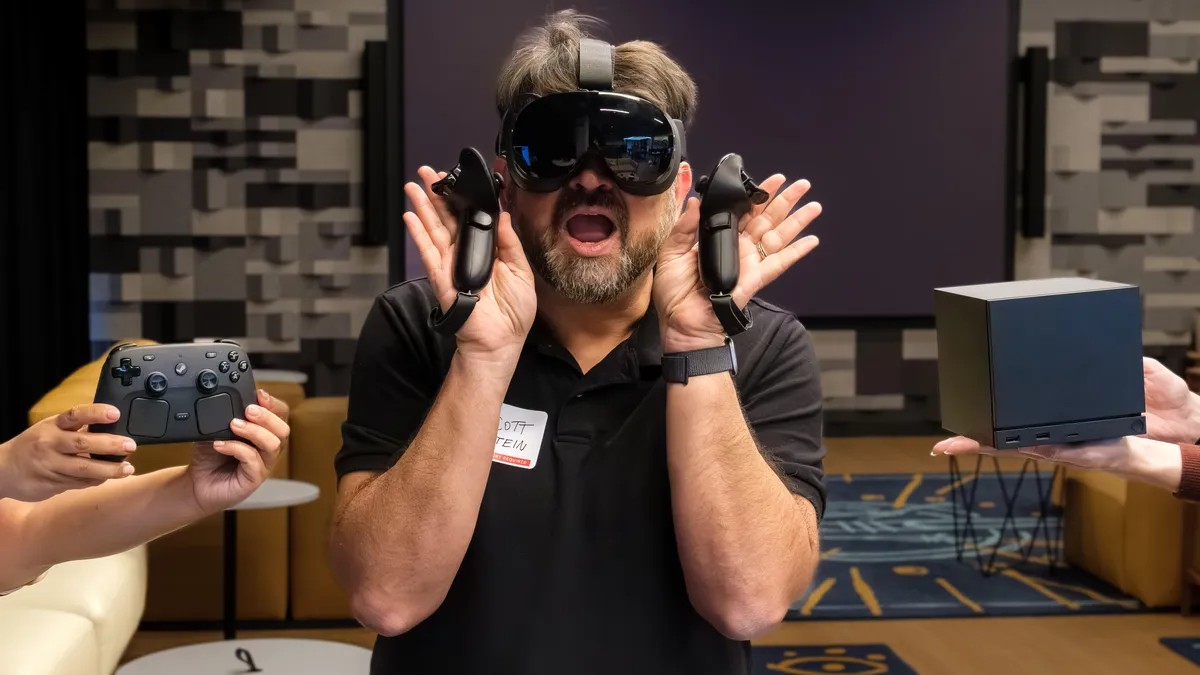
Valve, the gaming giant behind the Steam platform, is preparing a major push into new hardware territory with the Steam Frame VR headset, Steam Machine console-PC hybrid, and a redesigned Steam Controller. These three interconnected devices are slated for release in early 2026 and represent a bold attempt to redefine how PC gaming extends beyond the desktop – into virtual reality, living rooms, and beyond.
Зміст
The Steam Frame: A Steam Deck for Your Face
The most striking of the trio is the Steam Frame, a standalone VR headset that Valve describes as a “Steam Deck for your face.” Unlike many competitors focused on augmented reality, Valve is doubling down on immersive gaming. The headset runs SteamOS on an ARM chip, allowing users to load their existing Steam library directly from a MicroSD card or stream wirelessly from a PC.
The device boasts a Snapdragon 8 Gen 3 ARM64 chip with 16GB of RAM, a 110-degree field of view, and a 2,160 x 2,160 LCD display per eye. Valve also integrated foveated rendering and streaming, dynamically adjusting visual fidelity based on where the user is looking to optimize performance without noticeable quality loss. The controllers feature a Steam Deck-inspired layout, including a d-pad for seamless compatibility with existing Steam games.
Valve’s approach to VR differs significantly from Meta, Apple, and Samsung, focusing solely on gaming rather than mixed reality or AI integration. This clear focus could carve out a unique niche for the Steam Frame in a crowded market.
The Steam Machine: PC Gaming Reimagined
The Steam Machine is Valve’s return to the console-PC concept, offering a cube-shaped device designed to connect to televisions. It features a semi-custom AMD Zen 4 CPU and RDNA3 GPU capable of 4K gaming at 60 frames per second with ray tracing. Valve claims it’s six times more powerful than the current Steam Deck.
The machine will be available with or without the new Steam Controller, emphasizing compatibility with existing peripherals. Magnetic faceplates and an LED progress bar add a touch of personality. While early testing showed some performance inconsistencies in certain titles, Valve expects optimization to improve as the launch date nears.
The Steam Controller: Wireless Freedom
The redesigned Steam Controller prioritizes responsiveness and comfort. It features Hall-effect magnetic analog sticks with reduced dead zones, stronger haptics, and gyro-based controls. A new 2.4 GHz wireless protocol ensures lag-free connectivity. The controller is cross-compatible with the Steam Deck and Steam Frame, offering a unified experience across all three devices.
Beyond Hardware: An Ecosystem Play
Valve’s strategy isn’t just about selling individual products; it’s about building an interconnected gaming ecosystem. The company envisions these technologies extending to third-party products, with SteamOS potentially running on other hardware.
Valve’s history demonstrates a willingness to license its technology, and the Steam Machine and Steam Frame could serve as blueprints for future devices. The Steam Deck’s success has already paved the way for other handheld PC gaming consoles, and the Steam Frame could inspire a new wave of VR headsets.
The exact pricing remains unknown, but Valve’s approach suggests a long-term investment in pushing PC gaming forward – whether through its own hardware or by influencing the broader market.
Valve’s move to expand SteamOS across handhelds, consoles, and headsets is ambitious. If successful, it could redefine the landscape of gaming, blurring the lines between PC, console, and VR.