
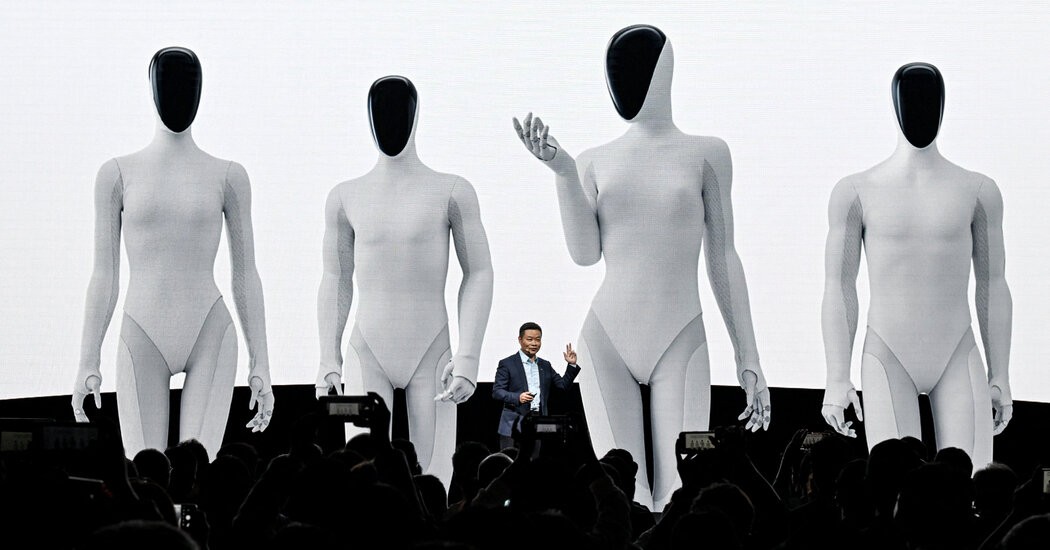
China’s robotics industry is experiencing explosive growth, marked by viral demonstrations of humanoid robots that perform stunts like dancing, boxing, and even running marathons. Recent public scrutiny, exemplified by a company being forced to dismantle one of its robots onstage to prove its mechanical nature, highlights both the excitement and skepticism surrounding this rapid expansion.
The Rise of Chinese Robotics
Chinese companies are flooding the market with robots capable of mimicking human movements and completing basic tasks. However, these machines often lack the sophistication required for complex real-world applications currently handled by human workers. Despite this, over 150 manufacturers are competing for market share, leading to concerns about a potential bubble.
Beijing has officially warned of the risk of excessive redundancy, stating the industry is at risk for a flood of “highly repetitive products.” This situation mirrors earlier surges in sectors like electric vehicles, where China aggressively pursued early dominance.
Global Leadership and Factory Transformation
China is now the world’s largest consumer of industrial robots, surpassing all other nations combined. Factories across the country have embraced automation, deploying robots for tasks such as welding car parts and handling logistics. The presence of robots is also becoming increasingly visible in public spaces.
Robots are now common in hotels delivering room service, airports maintaining floors, and university campuses handling package deliveries. At the 2022 Winter Olympics, robots even cooked and served food in canteens.
The “Attack-First” Approach
According to Lian Jye Su, chief analyst at Omdia, China’s strategy is to aggressively adopt new technology, leading to intense competition among vendors for limited market share. This mirrors China’s approach to EVs, where rapid expansion was followed by consolidation.
The key question isn’t whether China can make robots, but whether the market will sustain this level of production given the current state of technological capabilities and economic realities.
The current robotics boom in China is a sign of its ambition in high-tech manufacturing, but the long-term sustainability of this rapid growth remains uncertain. The industry faces the challenge of converting hype into real-world value before a potential correction occurs.