
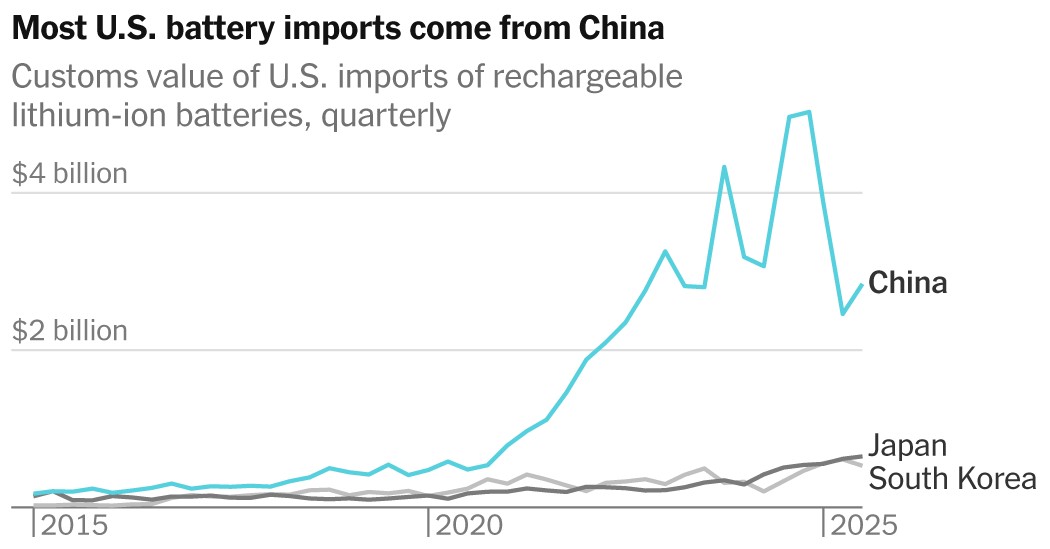
The United States’ ambitions in artificial intelligence (AI) and modern warfare are increasingly dependent on a critical supply chain dominated by China: batteries. From the massive data centers powering the AI race to the future of military technology, U.S. industries and defense officials recognize this as a growing national security risk.
The AI Industry’s Hidden Dependence
Northern Virginia’s sprawling data centers, the heart of American AI development, consume staggering amounts of energy – comparable to small cities. Maintaining uninterrupted power is crucial; even brief outages can corrupt sensitive AI algorithms. To mitigate this, tech companies are aggressively investing in large-scale lithium-ion battery storage.
However, China currently leads in both the technology and production scale of these batteries. According to Dan Wang, a technology expert at Stanford’s Hoover Institution, “China is leading in almost every industrial component” in this field. This means U.S. AI development is indirectly reliant on its geopolitical rival.
Military Implications: A Vulnerable Future Battlefield
The Pentagon faces a similar dilemma. Modern warfare, as demonstrated in Ukraine, is rapidly evolving, with drones, laser weapons, and other advanced systems requiring massive battery power. The U.S. military anticipates needing millions of batteries to maintain its technological edge.
Unfortunately, many of these batteries are sourced from China. Govini, a defense analytics firm, estimates that U.S. forces currently rely on Chinese supply chains for at least 6,000 individual battery components across various weapons programs. This dependency isn’t new to sectors like auto manufacturing, but the implications for national security are now critical.
Why This Matters: A Strategic Weakness
The concentration of battery production in China creates a systemic vulnerability. Disruptions to this supply chain—whether due to geopolitical tensions, trade disputes, or domestic policy changes in China—could severely hamper U.S. AI development and military readiness.
The situation highlights the need for strategic diversification, domestic battery manufacturing, and securing alternative supply routes. The U.S. is facing a fundamental challenge: maintaining technological leadership while simultaneously relying on its primary competitor for a key enabling technology.
Ultimately, the U.S. must address this dependency swiftly to avoid becoming strategically disadvantaged in the coming decades.