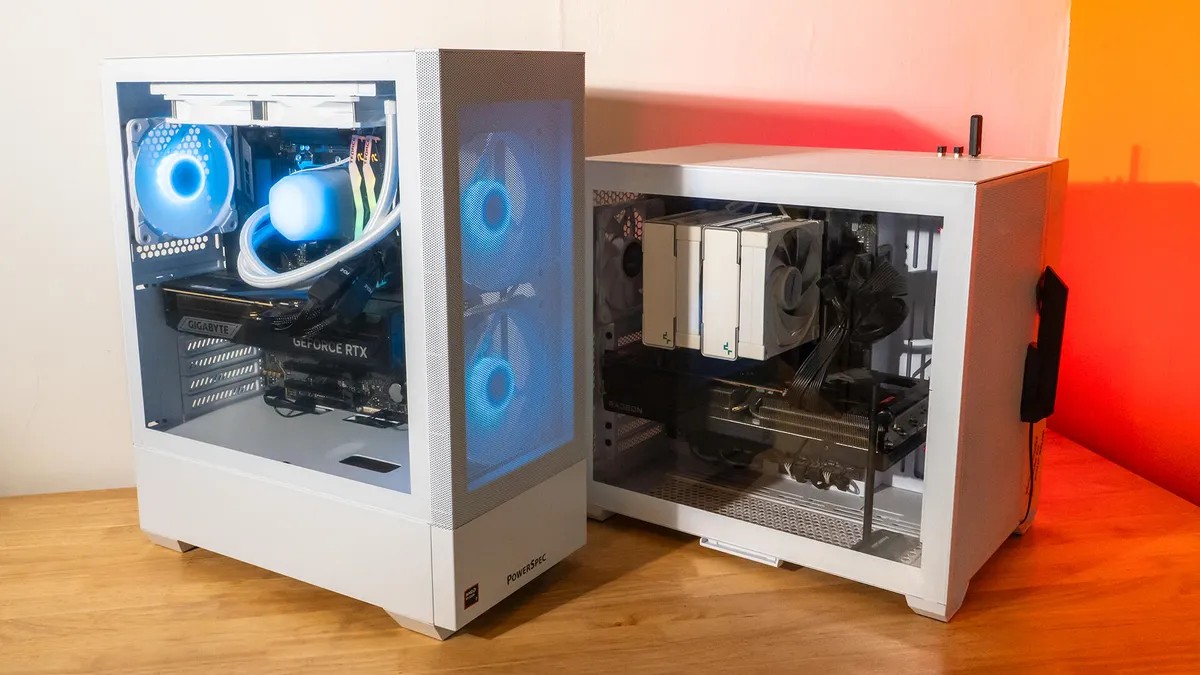
Ten years ago, building a PC was a flex. It saved you money. It gave you control.
Now?
It’s just expensive.
The component market has gone haywire. AI demand caused RAM prices to spike, NAND storage costs inflated, and GPUs refuse to drop below retail even when you can find stock. It’s a mess. Manufacturers and boutique builders have supply chains that DIYers dream about. They buy in bulk. They negotiate prices.
I wanted to prove a point.
Or maybe I just wanted to stop blaming myself for losing the game.
I compared competitively priced prebuilt systems against equivalent DIY configurations using PCPartPicker.
The results?
Building your own PC isn’t cheaper anymore.
Зміст
Every End of the Market Is Hit
This isn’t just about high-end gaming rigs with three-monitor setups and RGB fans that cost more than my car.
The bleed happens everywhere.
Budget, midrange, high-end. DIY loses against prebuilts at every price tier.
Take the budget sector. Usually the sweet spot for savers.
HP Omen 16L at Sam’s Club costs $1,199 same CPU, same GPU, similar RAM and storage. You DIY that same build. You hit $1,544 before you even unpack the screwdriver.
Lenovo LOQ Tower at Micro Center? $999.
Try matching it yourself.
You’re at $1,071 for the bare bones.
You don’t even have a motherboard yet because Lenovo used a proprietary one with a laptop chip.
Good luck sourcing that.
Midrange gets worse.
Sam’s Club has an Asus ROG G700 for $1,749 It has a Core Ultra 7 266KF. 32GB DDR5. RTX 5070. 2TB SSD.
I tried to be cheap.
I really did.
I picked a $74 case. An $89 PSU. A $54 air cooler.
Don’t skimp on PSUs. Seriously. But even giving those three items away for free would only drop my DIY cost to $1,816
Still over by $67.
High end? Volatile.
One prebuilt was $650 more than DIY. Another was $600 less.
The margin swings are massive because the absolute prices are higher. But it doesn’t matter that some are overpriced.
Bad apples ruin the barrel.
Average price differences hide the truth. You only need one good prebuilt deal to make DIY look foolish.
Where You Shop Matters
You can’t just pick a brand and hope for the best.
Major OEMs are struggling to look good right now.
Dell’s Alienware Aurora was $620 more expensive than DIY.
Lenovo’s Legion Tower 7i? $456 over.
HP’s Omen 35l? $73 over.
Though their budget 16L model beat DIY by nearly $200.
Acer? Nothing worth considering.
Asus wants $300 more on their own website for the G700 than Sam’s Club charges.
And a Sam’s Club membership is $40 a year. Not $300 a build.
Best Buy?
They saved us during the GPU shortage in 2021.
Not today.
Unless you’re buying Yeytian or Andromega Insights brands. Which sound like fictional characters from a tech noir novel.
The decent deals there averaged $130 over DIY.
An HP Omen 35i had a $200 instant discount that undercut DIY by $80.
That sounds good. Until you find cheaper, better rigs elsewhere.
Boutique builders are a gamble.
iBuyPower RDY Trace X beat DIY by $150.
Maingear’s Classic line? Averaged $420 more expensive than doing it yourself.
Costco?
Known for member perks.
Still missed.
Six prebuilts averaged $222 over DIY.
Two were wins. Four were losses averaging $400 extra.
The CLX brand via Costco Next saved me $185 compared to DIY.
So there is light. Just not everywhere.
Micro Center Is King (If You Have Legs)
If you have a Micro Center near you, you’re winning.
The DIY Mecca.
Stocked to the ceiling.
Their prebuilt section, especially the in-house PowerSpec brand, beats DIY consistently.
Average savings of $336.
Maximum savings of $632 for the PowerSpec G707.
An Alienware Aurora model was $532 cheaper than the parts list.
But here is the catch.
Most of these are in-store pickup only.
Two shippable desktops? Neither was cheap.
The HP Omen Max 4SL was still $297 cheaper than DIY despite costing $5,400.
But you need to be able to drive there.
Geography is a feature now.
Upgrades Are Still Your Friend
So is DIY dead?
No.
But buying a whole system is dead.
I built a “value” mid-range machine recently. Core Ultra 7. RTX 5090. 32GB RAM.
$2,377.
That is close to an Alienware Aurora with an i9 and RTX 4090.
My first PC? An iBuyPower in 2010. FX 8328. GTX 900.
Cheap.
I’ve never bought another full system since.
I upgrade pieces.
GPU swap. New case. Ryzen migration. More RAM. More storage.
The SSD from 2016 still spins in my chassis.
Every single upgrade cost less than buying a new prebuilt.
They added performance without resetting my investment to zero.
Start with a cheap prebuilt if that’s the better deal.
Upgrade later when components drop or new tech emerges.
There is no shame in playing the long game.
How I Crunched The Numbers
I assumed prebuilts used the worst parts possible.
Vague SSD spec? I assumed SATA. The cheapest SATA drive available.
Turns out I was wrong often. PowerSpec puts in PCIe 5.0 drives even if they don’t scream it online.
I matched CPU, GPU, and RAM exactly.
For PSUs and cooling, I kept it standard. 700-watt unit. All-in-one AIO cooler.
Why? Reliability.
Cheaper PSUs break.
Cheaper coolers fail.
You lose more fixing that than you save upfront.
I added a $140 Windows license to every DIY build to make the comparison fair.
Even then?
The parts usually cost more than the finished box.