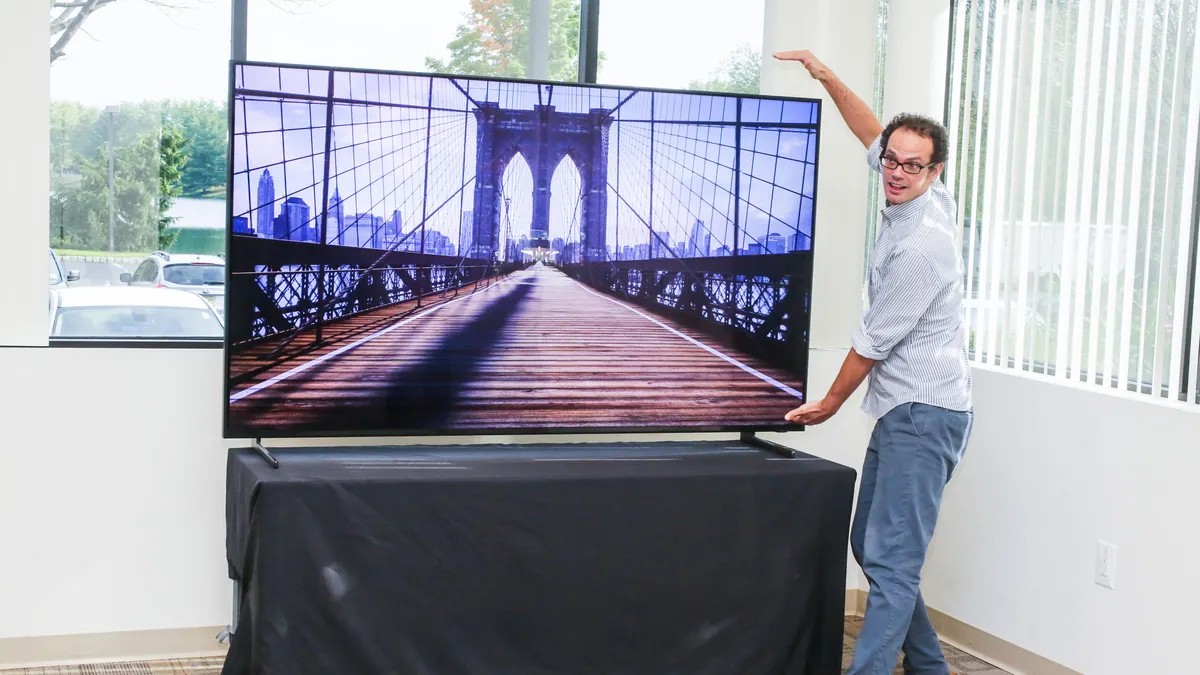
The old adage “buy the biggest TV you can afford” remains largely true, but it requires nuance. As television technology advances, larger screens have become significantly more affordable, making high-end 65-inch and 85-inch models accessible to a broader audience than ever before. However, simply maximizing size isn’t always the optimal choice. The ideal screen size depends on a balance of viewing distance, room dimensions, resolution capabilities, and personal comfort.
Determining the perfect size involves more than just measuring your wall; it requires understanding how your eyes interact with light and pixels. Here is a breakdown of the key factors to consider when selecting your next television.
Зміст
The Science of Viewing Distance
The most critical variable in TV sizing is your seating distance. The farther you sit from the screen, the smaller the TV appears in your field of view. Industry standards provide mathematical guidelines to help optimize this relationship, ensuring that the image is immersive without being overwhelming or causing eye strain.
Two major organizations offer distinct recommendations:
- THX (Audiovisual Technology Company): THX recommends a viewing angle of approximately 40 degrees. To calculate the ideal diagonal screen size, multiply your seating distance (in inches) by 0.835.
- Example: If you sit 9 feet (108 inches) away, THX suggests a screen roughly 90 inches diagonally.
- SMPTE (Society of Motion Picture and Television Engineers): SMPTE offers a more conservative guideline, suggesting the viewing distance should be 3 to 3.2 times the height of the picture. To find the diagonal size, multiply your seating distance by 0.68.
- Example: At a 9-foot distance, SMPTE recommends a screen around 73 inches.
Why this matters: These calculations are not rigid laws but rather benchmarks. Most modern viewers find that a screen falling between these two ranges—often around 65 to 75 inches for a standard living room—provides the best balance of immersion and comfort.
Resolution vs. Screen Size: The 4K Reality
With nearly all new televisions featuring Ultra HD (4K) resolution, the relationship between screen size and pixel density has shifted. In the past, sitting too close to a large 1080p TV would reveal individual pixels, creating a “screen door” effect. Today, 4K technology has largely neutralized this issue for most living room setups.
- You likely don’t need 8K: For most viewers sitting more than six feet away, the human eye cannot distinguish the difference between 4K and 8K resolution. The jump in detail is negligible unless you have an exceptionally large screen (100+ inches) or sit very close to it.
- The content caveat: A larger screen exposes flaws in lower-quality content. If you primarily watch standard definition (SD) or highly compressed streaming video, a massive TV may reveal blockiness, noise, and artifacts that were invisible on a smaller screen. Ensure your streaming services and source devices support 4K HDR to fully utilize a large display.
Room Dynamics and “Visual Domination”
Beyond mathematics, there is the aesthetic factor of “room domination.” A television is a large, dark object that can visually overwhelm a space, especially when turned off. An 80-inch TV in a small room can make the space feel cramped and unbalanced.
Practical Tip: Before purchasing, create a life-sized mock-up of the TV using cardboard or painter’s tape on your wall. Cover it with black cloth to simulate the glossy black finish of a modern TV. This helps you visualize how the device will look in your room, both on and off, and allows you to gauge its impact on the room’s overall decor.
Comfort and Eye Strain
Viewing comfort is highly subjective but physiologically significant. Many experts and enthusiasts argue that larger screens can actually reduce eye strain in dark environments.
- The Brightness Factor: In a dark room, a small, bright TV acts like a concentrated light source, forcing pupils to constrict against the surrounding darkness. This contrast can lead to fatigue or headaches.
- The Immersive Advantage: A larger screen fills more of your peripheral vision with a uniform brightness level. This reduces the stark contrast between the screen and the dark room, allowing your eyes to relax. Some users even prefer projectors for this reason, as they spread light over a wider area, though TVs generally offer superior brightness for rooms with ambient light.
Final Recommendation: When in Doubt, Go Bigger
While personal preference plays the largest role, the trend is clear: larger screens are generally preferred once they fit the space.
A 50-inch TV, which was once considered a premium size, now feels comparable to the 36-inch CRT televisions of the past. Given that 65-inch, 75-inch, and even 85-inch models are now competitively priced, they offer a significantly better value and viewing experience for most households.
Key Takeaway: If you have the wall space and budget, err on the side of larger. Most consumers report that they never regret buying a TV that is slightly larger than they initially thought they needed, whereas smaller screens often feel limiting once installed.
For those seeking the ultimate cinematic experience with control over ambient light, a high-quality projector remains a viable alternative to massive flat panels, offering screen sizes that dwarf even the largest TVs.