The history of music is full of dramatic changes. We remember the invention of the first musical instruments. I also remember how recording technology has made an infinite number of sounds possible. We still remember the moment Bob Dylan plugged in his electric guitar and alienated the folk purists. But perhaps the biggest change in recent decades isn’t the music itself. It’s about how we consume it.
The shift to mobile devices as the primary music delivery system is changing everything. Smartphones, tablets and MP3 players bring your entire song library into your pocket. Convenience wins. But this convenience comes at a price. Of course, it’s more intimate when you listen to it with headphones. But it is also isolation. Most mobile devices don’t have built-in speakers to provide enough volume for a room full of people. The sound is thin. It’s missing an ingredient.
A portable Bluetooth speaker seems like an obvious solution. But many still fall short. They tin. They strive hard for meaningful bass. It sounds like a toy trying to be a home appliance.
There is another method. Type Vibration Speaker (also known as Vibration Sensor ). These devices completely bypass traditional cone and magnet setups. Instead of pushing air, it vibrates the surface it is attached to. Attach one piece to the window glass. Place it on a glass table. Suddenly, that entire surface becomes a driver. The results can be very satisfying. An unassuming little puck can fill a room with a deep, resonant sound.
How can a device the size of a coaster produce so much power? To understand this, we need to look beyond this gadget and into the physics of sound itself.
Зміст
The Physics of Propagation
The essence of sound is movement. This is not magic. This is a collision of molecules. When you play a string or beat a drum, you create an impulse. The molecules of the surrounding medium react. They beat their neighbors, and their neighbors beat their neighbors. We consider this chain reaction to be sound.
In a gas, like air, the molecules jump around randomly. Its speed depends on the temperature. Cold air means molecules move more slowly and collide more slowly. The hotter the air, the more chaos it creates.
But air is not the only medium. Sound travels faster in liquids and solids. Why? This is because the molecules are tightly packed together. They are dispersed in gases. Both liquids and solids are tightly packed. Tighter packing means faster collisions, which means faster transfer.
Let’s think about the numbers. At 0 degrees Celsius (32 degrees Fahrenheit), sound travels through air at a speed of 331 meters per second. About 740 miles per hour. Fast for humans, slow for physics. Sound travels through liquid mercury at a speed of 1,450 meters per second. It flies through the solid glass at a speed of 5640 meters per second. The denser the medium, the faster sound travels.
Sound radiates outward from its source in the form of waves, like the waves caused by a stone thrown into a pond. These waves lose energy as they expand. The further you are from the sound source, the quieter it becomes. Sound waves are defined by two main factors: frequency and intensity. The higher the frequency, the higher the pitch. Intensity determines the volume, which is determined by how much the wave changes the air pressure. The greater the change in pressure, the louder the sound.
From ear to brain
So what do these molecular collisions really sound like? Thanks to the eardrum.
This membrane is located inside the ear canal. It vibrates when colliding molecules hit it. These vibrations are picked up by the small bones of the middle ear and transmit their movement to the cochlea. The cochlea is a fluid-filled spiral structure located in the inner ear.
The vibration causes pressure waves in the liquid. The inner ear contains the organ of Corti, a sensory structure that converts these pressure changes into electrical impulses. These impulses travel along the auditory nerve to the brain. The brain does the heavy lifting by interpreting signals into music, speech or noise.
This process is completely dependent on the medium. If the molecules do not collide, there is no sound.
Vacuum problems
That’s why no one in space can hear you scream. Space is a vacuum. The molecules are too far apart to interact. There are no collisions. There are no chain reactions. There is no sound. If you want complete calm, look up at the stars. It’s the only place that truly delivers it.
Speaker connection
Traditional speakers work by vibrating the cone to force air out. Vibration speakers take a different approach. Transfers mechanical energy directly to solid surfaces. The surface itself becomes a film. It vibrates and moves the air above it. Because solid objects transmit sound more efficiently than air, these devices can produce surprisingly loud sound in a small footprint. Surface area is important. The bigger the table or window, the bigger the vibrating mass and the richer the sound.
This is a clever solution to the limitations of modern small electronic devices. these transducers turn everyday objects into sound power sources by exploiting the physical properties of dense materials.
You probably already know the construction of a standard speaker. Visible parts such as suspension, diaphragm and dust caps are only the tip of the iceberg. The suspension holds the film in place. The film is conical in shape, as you can see, with a dust cap in the middle. Behind the cover is the real workhorse: the voice coil.
A coil is a moving electromagnet. When current flows, a magnetic field is created. Flip the current, and you flip the polarity. There is a permanent magnet at the bottom of the speaker. When the magnetic field of the coil coincides with the permanent magnetic field, they repel each other. The coil pushes out, which drives the film forward. Reverse polarity? They attract. The coil pulls back, dragging the diaphragm with it.
The fast alternating current causes the coil to bounce up and down. The membrane compresses and dilutes the surrounding air in the same way. Those pressure waves are sound. The amplifier provides the specific electrical patterns needed to reconstruct the audio signal.
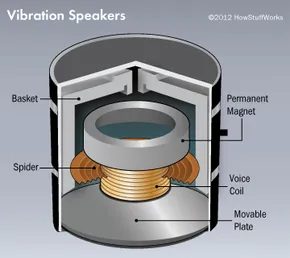
Next, see the vibration speaker. It strips away the diaphragm entirely. Instead, the voice coil is connected directly to the moving plate. Placing the disc on a solid object provides a different type of sensor. A Converter is a device that converts one form of energy into another form of energy. Here, electrical energy is converted into mechanical energy and then into sound waves in the air.
When the coil vibrates, it shakes the plate. The plate shoves against the surface. That surface begins to vibrate too. It displaces air molecules just like a cone would. Your ears catch those collisions. Not all materials are created equal, though. Glass and wood generally resonate better than dense metals or thick plastics. You can hide these speakers inside the walls. The walls themselves act as speakers, invisible and spreading sound throughout the room.
Manufacturers are already getting creative with this technology. You can stick a vibration speaker to a ski helmet. It stays secure while you listen to music on the slopes. The desktop version removes the clutter of visible boxes and turns the entire desktop into one sound source. Then there are bone-conduction variants. It completely bypasses your ears and transmits the vibration directly through your skull. You hear the music, but you also feel it.
The physics is simple. The application is anything but.