Imagine John Book breaking out of his barn-raising habits and entering a world he barely recognized. The Amish don’t worry about software updates or Bluetooth pairing. They are worried about horses, crops and quiet. But if this cop from 1985 had to drive on today’s roads, he probably wouldn’t get lost because of the noise. He gets lost because of the key. Or rather, it’s missing.
The situation in the automotive industry has changed dramatically in the last decade. We’ve moved from mechanical locks and physical master keys to apps, cards and signals. For tech-savvy drivers, this feels like progress. Is it for people who just want to drive? It feels like a new language.
Enter Keyless Ignition. It is not a luxury. It’s not just a “cool gadget” anymore. It is the baseline. If you bought a new car and still have a metal blade in your hand, you’re doing it wrong.
Зміст
How keyless entry works
You probably do this every day without thinking. You put the key ring in your pocket and headed to your car. The door opened. Slide and press the start button. You drive away.
It is magic to the uninitiated. It is mundane to you.
But this is reality. Keyless Entry Systems use Radio Frequency Identification (RFID) or Near Field Communication (NFC) to authenticate your identity. The car talks to your key fob. the key fob answered. No problem if the signal is strong enough.
“Comfort is undeniable, but the safety model is weak.”
This simplicity puts the unprepared at risk. If you lose your key fob, you lose everything. There are no physical backups. There is no master key. Just a digital ghost.
The Amish Man’s Dilemma
让我们回到约翰·布克。 他坐在一辆现代轿车里。 他不知道钥匙孔在哪里。 没有一个。 他看到一个标有“开始 ”的按钮。 他按下它。 发动机轰鸣起来。
他很困惑。 他也释然了。
对于普通驾驶员来说,向无钥匙点火 的过渡一直很不和谐。 我们忘记了如何锁车。 我们把钥匙留在车里。 我们被锁定是因为遥控钥匙的电池没电了,而且我们没有隐藏在手柄内的机械超控装置。 这是一个便利的悖论。 我们获得了易用性,但却失去了对身体的掌握。
Why It Matters Now
这种趋势并没有放缓。 Legacy brands are phasing out physical keys. Luxury brands have already killed them. 即使是经济型汽车也在采用这项技术来降低制造成本并吸引那些认为物理钥匙过时的年轻买家。
如果您正在考虑购买新产品,请忽略有关加热座椅或全景天窗的炒作。 重点关注无钥匙进入 系统。 怎么会失败呢? 有物理备份吗? 如果密钥被盗,您可以追踪它吗?
These aren’t minor details. They are the difference between a smooth commute and a tow truck ride.
The Verdict
John Book would hate the noise. He would hate the screens. But he would appreciate the keyless ignition. It is quiet. It is efficient


Imagine John Book, that dark police archetype who worked in Amish society for decades starting in the 1980s. He’s used to yelling, “Throw me the keys!” at a fellow officer so he can jump into a patrol car and chase criminals. It’s a dramatic, high-stakes routine. Now imagine the same scenario in a modern vehicle. There is no need to physically hand over the keys. The thrill of the chase remains, but the mechanics of getting into the car have changed fundamentally.
It’s not just about comfort for luxury’s sake. It’s about efficiency and safety. Many modern vehicles have remote ignition, a feature that is especially valuable during the freezing winter months. You press the button on your fob and the car starts to heat up. At the same time, the doors are locked. This double effect prepares the interior for comfort and prevents opportunistic theft. However, if you really want to keep your hands free – perhaps in a more urgent crisis or just to get around metal keys – you should check out keyless ignition systems.
The technique here is straightforward, but effective. You carry a specialized key fob in your pocket. A sensor in the vehicle detects the presence of a trailer. When the system confirms that the key fob is nearby, the ignition is ready. The driver just presses a button on the dashboard and presses the brake. No turning a metal key. No inserting anything into a slot. This keyless entry and start method streamlines the process significantly.
It has tangible benefits beyond just avoiding the cold. The system is designed for safety. The personal codes used by the key fob and the reader make it difficult for thieves to bypass the ignition. For a crime fighter like Book, this means less time to worry about a stolen vehicle and more time to work. But the impact extends beyond law enforcement. People with arthritis or other physical limitations find that eliminating the twisting and turning of a traditional key reduces the stress on their joints. It’s a small change that improves the daily quality of life for millions of people.
4: Reversing camera
Speaking of safety, we talk about visibility. Reversing a car used to be in hope and a quick glance over your shoulder. Now it’s a digital process.
Reversing camera has become standard equipment on many new models and is required by safety regulations in many areas.
These cameras are installed near the license plate or trunk handle.
When you shift into reverse, the display on the dashboard or infotainment screen is activated. It shows a live video feed of the area behind the vehicle.
Some systems have dynamic guidelines that move as the steering wheel is turned to help estimate distances and angles. This technology reduces blind spots. It prevents accidents involving children, pets or objects that otherwise go unnoticed.
Integrating these cameras with parking sensors creates a multi-layered approach to security. The camera provides visual context, while the sensors provide audio alerts when you get closer to obstacles. This combination has likely prevented countless minor collisions in parking lots and driveways. For everyday drivers, that means less anxiety when maneuvering in tight spaces. For parents, it provides a layer of protection for children playing nearby. Technology is no longer a luxury; It is an essential safety tool. As vehicles continue to evolve…


The logic applies. If the fictional cop in the 1985 thriller prioritizes the protection of an Amish child witness, you should definitely prioritize the safety of the real children walking the streets with you. This is the core promise of back-up cameras. It’s not just about their comfort. They care about preventing tragedies.
According to the safety group Kids and Cars, the stakes are shockingly high. Two children are killed every week. In addition, 48 were seriously injured. All because the driver reversing the vehicle did not see them. It’s rarely evil. Drivers are not bad people. You are dealing with a huge blind spot right behind your car. It’s the perfect hiding place for small children playing nearby.
How Back-Up Cameras Work
The solution is straightforward. The reversing camera sends a live video feed to the dashboard screen. The image appears as soon as you engage the reverse gear. You see what the rearview mirror can’t show you.
Even if you don’t worry about children or pets, the benefits remain high. You can park exactly parallel. Without the guesswork, you can align your vehicle to the trailer hitch. The technology is available in two main ways. The system is already pre-installed in some new vehicles. Others are available as aftermarket add-ons. You can choose between wired units that connect directly to the reverse lights, or wireless versions that transmit radio frequency. Both options take the guesswork out of the equation.
Bluetooth connection in vehicles
3: Bluetooth
Cameras eliminate visual blind spots, while Bluetooth takes care of the communication gap. This wireless standard allows devices to communicate with each other without physical cables. In the automotive industry, it is primarily used for hands-free calls and audio streaming.
Why is this important for everyday drivers? Distraction is the most common cause of accidents. Trying to dial a number or look for a phone while driving takes your eyes off the road and distracts you from the task at hand. Bluetooth solves this problem. Once paired with your smartphone, calls can be answered and ended with the push of a button on the steering wheel or a voice command. You keep your hands on the steering wheel and focus on the road.
In addition to calls, Bluetooth also transmits music from your phone to the car stereo. This eliminates the need for auxiliary cables or cassette adapters. It offers a cleaner installation and often better sound quality than older connection methods.
Which Bluetooth version do you need?
Not all Bluetooth devices are created equal. Early versions were slow and prone to interruptions. Newer versions offer faster pairing and better battery efficiency. Most modern cars use Bluetooth 4.0 or higher. This ensures stable connections for both calls and media. If you are installing an aftermarket device, check the specifications. If the version is older than 3.0, you may experience delays or disconnection during a long drive.
Where is Bluetooth located?
In factory-installed systems, the hardware is integrated into the vehicle’s infotainment module. You can usually access it from the main screen or from a separate menu button. Aftermarket head units have their own internal Bluetooth radios. These are often easier to upgrade if your car is older. They connect to the existing wiring harness and display pairing instructions on their own screens.
The real advantage is integration. When the phone connects, the car knows. Music is playing from the speakers. call audio comes through the

Hands-free lifeline
John Book was in trouble. The bad guys were calling with ransom demands, but he was driving through a state with strict hands-free laws. Manually answering the cell phone was off the table. If these were the old days, he’d have pulled over to a pay phone, made himself vulnerable, and the ransom negotiations would have stalled. But technology had advanced. He didn’t have to leave his car. All he needed was Bluetooth.
It’s not just about convenience. It’s about staying alive while keeping your hands on the wheel. Bluetooth acts as an invisible bridge between your phone and your car. This allows compatible devices to communicate with each other without tangled cables. For drivers, this means they can sync their devices and make calls safely. Some modern cars are equipped with this built-in device. Others require you to purchase a separate receiver to turn your dashboard into a hands-free zone. Once the connection is made, the process is almost magical. You speak a name. The car dials. The other person’s voice is heard through your speakers. No fumbling. No distractions. Simply clear communication.
For more ideas to enhance your vehicle, see 5 Best Bluetooth Car Accessories. But navigation is just the beginning of what these wireless connections can do.
2: Navigation system
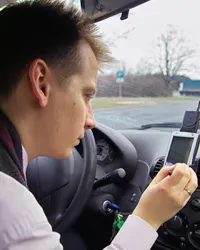
The days of paper maps and aimless looping are officially a thing of the past. Today’s navigation systems handle the heavy lifting and provide precise route guidance from your starting point to your destination. Enter your start and end points, and the device plots a route based on data from government-controlled navigation satellites. All you have to do is listen to the voice prompts (yes, on some models you can actually choose the voice of the navigator) and follow the route.
These devices cover a wide price range. You can buy an inexpensive unit that mounts to your dashboard, or you can buy a system that is factory-installed in your new car. Some devices also serve as entertainment centers, with MP3 players and directories to help you find the nearest pizza place.
If you’ve been in an Amish community since the mid-1980s, chances are you’ve seen real-time traffic updates as if someone is yelling about cows blocking the road. But for the rest of us, real-time data is the next logical step for these devices. Soon, your navigation system will not only guide you, but also help you. It predicts trouble. Detect accidents during your normal commute and automatically reroute to avoid holiday rush hour.
iPod connection
Integrating a mobile music player into your car’s dashboard isn’t just about convenience. It’s about centralizing your digital life.


Playlist from the driver’s seat
Of course, that joke means nothing to the Amish. John Book points to a coffee ad he’s never seen before, pointing to a cultural gap that highlights the advancement of technology. But the most important thing is that you don’t have to watch ads anymore. This is a real win.
The number of satellite channels is endless. You can order monthly. If you want, you can also get an 80s music channel. It is very convenient. It is very rich.
But comfort is not the only thing driving here. Loyalty runs deeper.
People have a musical obsession with iPod car accessories. They built a library. They curate playlists. They want a certain sound from a certain car.
Manufacturers also take note. They are looking at iPhone users. They found a loyal following for the iPod. So they started building special hooks.
Why direct connection is better than Bluetooth
You might think that Bluetooth is now a standard. Works for calls and basic voice. But for pure musical fidelity and control, a direct connection is best.
Many vehicles now have an MP3 player connection as standard. This is becoming the norm. But some manufacturers go further. They design user interfaces that interact directly with Apple’s ecosystem.
Unique iPod connection will change the way you drive. It’s not just about connecting cables. It’s about integration.
“Drivers can select tracks through the car’s stereo system and in some cases also from the steering wheel.”
This is important. No need to fumble with the screen. You don’t have to take your eyes off the road. Use the controls you already know. The buttons on the steering wheel become an extension of the device in your pocket.
This is the most seamless method. No pairing errors. No dropouts. Just music.
Bridging the technology gap
We still have to explain the iPod to the Amish. They don’t understand coffee jokes. They didn’t get the playlist. They don’t get the tech.
But for the rest of us, the gap is closing. Cars are no longer just boxes on wheels. It’s an extension of your digital life.
If you want to upgrade your setup, there are many options on the market. Check out the Top 5 iPod Car Accessories to enhance the experience. Some offer charging. Some offer better sound quality. Some offer storage.
The choice depends on what is most important to you. control? Convenience? Cost?
There are other gadgets as well. Dashboard displays. RFID ignition system. Backup cameras. All these add layers to the driving experience. But what about the music? It’s still personal.
To learn more about how these devices work or why you might need one, check out our related guides Bluetooth car stereos or How Dashboard Displays Work.
The technology is still developing. The Amish are still watching. We’re just trying to keep up with the music.