The scale is ridiculous. 60 billion product listings. Google’s “shopping graph” refreshes constantly, tracking nearly everything for sale. And now they want to slap their AI on top of that mess to find you the right gear for the right price.
Revealed at the I/O conference Tuesday. A few new features. They aren’t trying to sell enterprise software. They want to turn your Google Search into a personal shopper driven by agentic AI.
Suresh Ganapathy—Senior Director of Consumer Shopping—told reporters ahead of the keynote that the goal is simple. He wants the experience to feel “fun and powerful and intelligent.”
“We keep hearing from shoppers that they enjoy the fun parts, but would love to delegate tedious bits to AI.”
Fair enough. Nobody likes reading specs at 11 PM.
Letting AI do the heavy lifting
The I/O announcements focus on making commerce seamless across the whole journey. Discovery, purchase, post-purchase. It’s all about the agent.
To handle the grind, Google is using UCP (Unified Commerce Protocol). Co-developed with giants like Shopify, Walmart, and Target. UCP lets agents and systems talk to each other.
There’s another layer too. Agentic Payments Protocol (AP2). This lets agents buy things within your specific constraints.
Think about it. You tell the agent to buy a blender. Budget: $50. Store: Target only. The agent executes the purchase only if all criteria are met. It keeps your payment data locked down via digitally signed contracts that show info only to necessary parties.
It sounds safe. Probably. Google says AP2-based products arrive this fall.
One cart, multiple stores
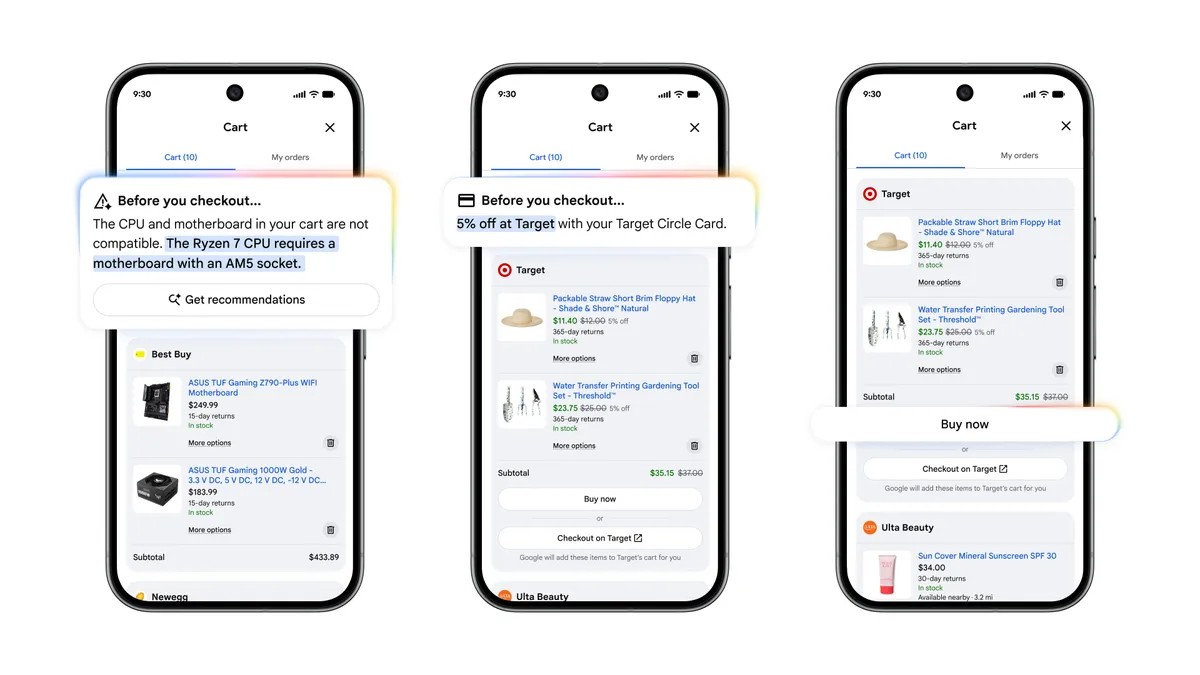
Here’s the visual trick. Universal Cart.
An agentic hub. You drop items you’re thinking about buying into one cart, regardless of where you found them. Search results. Gmail links. YouTube recommendations. All in one place.
But it doesn’t just hold stuff. It thinks.
It helps you maximize rewards. It proactively spots price drops, flagging when something hits an all-time low. It checks for compatibility, too—preventing you from buying a Lightning charger for your USB-C laptop.
The cart uses the advanced reasoning of the Gemini models to anticipate problems you wouldn’t even think of.
So now the AI finds the item. It negotiates the price logic. It pays securely.
It solves problems before they happen.
What part of the process is left for the human, then?