It’s not Boeing. Not this time.
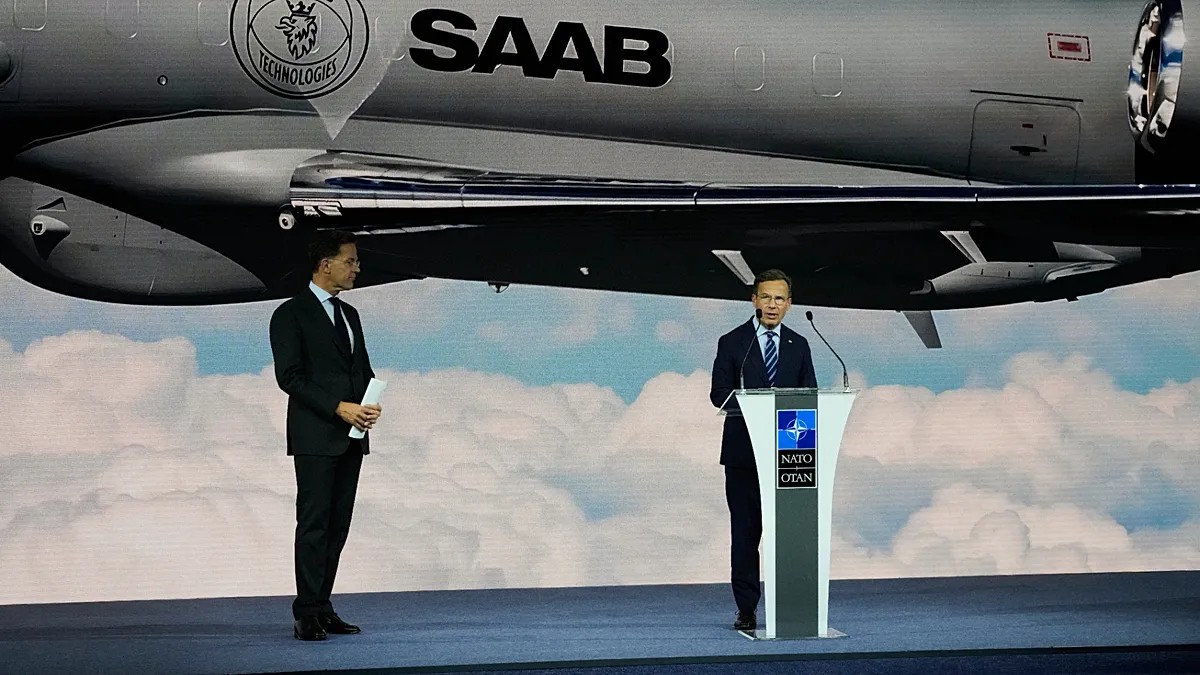
NATO has chosen Swedish defence giant Saab to build its next-generation airborne early warning system. The platform, called GlobalEye, is set to replace the alliance’s ageing US-built E-3A fleet. The announcement dropped at the NATO Summit Defence Industry Forum in Ankara. It feels like a pivot. A deliberate one.
The plan is simple. NATO will open talks to buy up to ten of these jets.
Зміст
Why replace the old birds?
Think of an Airborne Early Warning & Control (AEW C) aircraft as a flying command post.
It carries long-range radar and sensors high above the clouds. It sees everything. Missiles, ships, planes, even low-flying threats that ground radar misses because of curvature or clutter. Then it talks to your pilots. Tells them where to go. How to shoot. How not to die.
“In a serious security situation… the ability to detect threats early is becoming increasingly important.” — Pål Jonson, Swedish Minister of Defence
He’s right. Modern threats are messy. Drones, hypersonics, spoofed signals. You need situational awareness. Right now. GlobalEye promises exactly that.
Here is the rub. NATO usually relies on member states to fly these missions. But for early warning, NATO owns the planes itself. They are the “eyes in the sky” belonging to the alliance. And they are tired. Fourteen Boeing E-3As, flying since 1982, are hanging on by rust and willpower.
The Boeing ghost
This wasn’t even Saab’s first shot on goal.
Remember the E-7A Wedge-tail? NATO picked it in 2023. Boeing’s latest and greatest. Then, in 2025, the whole thing imploded. The US Air Force dumped it. Shifted budget toward space-based surveillance instead. Suddenly, NATO’s backup plan vanished.
Enter Saab. Again. Or maybe for the first real time.
Specs that actually matter
Saab markets the GlobalEye as the only system offering real-time air, sea, and land surveillance from a single deck.
It sits on top of the Bombardier Global 6000 business jet frame. Fast. Quiet. Efficient. It mixes active and passive radar sensors. Saab claims it can spot things over 550 kilometres away. In some conditions, farther. It stays up for more than 11 hours.
Compare that to the aging E-3A. Tracks objects to 400 km. Flies ten hours. Monitors an area roughly the size of Poland if it’s alone. Three of them cover Central Europe. Continuous scan.
GlobalEye’s coverage radius isn’t fully public yet. Saab isn’t spilling all the beans.
Eleven countries are backing this buy-in. Belgium, Canada, Denmark, the UK… wait, no, Germany. Latvia. Lithuania. Luxembourg. The Netherlands. Norway. Romania. Sweden. Eleven flags waving in unison.
No contract. Yet.
There is no pen on paper yet. Formal negotiations with the NATO Support & Procurement Agency begin now. It could get messy. Budgets are tight. Politics are tighter.
Saab CEO Micael Johansson is optimistic. To the point of aggressive scheduling. Tell Dagens Nyheter he wants to start deliveries by 2030. That is fast for a defence procurement cycle. Fast enough to hurt.
If the deal holds. If the sensors work as promised. If the business jet engines don’t quit.
We will see.