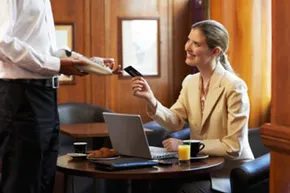
Technology has fundamentally rewritten the mechanics of commerce. Your restaurant order now hits the kitchen instantly. You tap a card for a taxi. You scan your own groceries as you load them into the cart. This is the reality of mobile point-of-sale systems. Wireless connections are actively dismantling the traditional checkout model. The shift is accelerating.
Point of sale (POS) is industry jargon for the exact spot where a retail transaction occurs. It is where money changes hands. Historically, cash and checks ruled. Merchants stuffed their revenue into physical drawers or boxes. Then came the cash register. Invented in the 1870s, it was a mechanical device designed to track revenues. It served as the first POS system.
Progress stalled for nearly a century.
The next major leap arrived in the 1970s with the barcode. Universal Product Codes began appearing on items in 1974. Merchants used scanners to read these codes. Sales processed faster. Accuracy improved significantly. Over the last twenty years, retailers added more gadgets to speed up lines. They introduced card swipe devices. They added signature pads. PIN pads became standard for debit transactions.
The 1990s changed the geometry of the store. Wireless computer networks emerged. These systems send radio waves through the air to transmit data. This allowed POS systems to go mobile. Restaurants adopted this technology first. Staff could process credit cards at customers’ tables. The payment process accelerated. Other industries followed.
Car rental companies added mobile POS to handle car returns curb-side. Hotels sent servers poolside with mobile devices to take drink orders. The friction of returning to a fixed counter vanished.
Some retailers are now eliminating centralized checkouts entirely. Clerks use portable computers to complete transactions on the floor. Apple stores offer the clearest example. They have removed cash registers. Representatives answer questions, check stock, and finalize sales using hand-held devices. The store layout is fluid. The transaction can happen anywhere.
Mobile POS is particularly useful in field operations. Hampton Jitney, a bus service carrying New Yorkers to Long Island, uses an onboard system. Attendants check reservations. They take payments. They print receipts on the spot. Small-scale merchants are also adapting. Flea market vendors and bake sale operators can now accept credit cards. They process transactions using ordinary mobile phones.
Security concerns persist. Wireless transactions raise questions about data integrity. Yet both consumers and merchants benefit from the availability of mobile POS. Retailers and service companies increase employee productivity. Labor costs drop. A restaurant server saves considerable legwork by reducing trips to the kitchen or cash register. Accuracy improves. Written orders are eliminated from the equation. Customers receive speedier service. They get error-free, detailed receipts immediately.
The infrastructure of retail is no longer fixed to a wall. It moves with the customer.
Where is mobile point-of-sale headed?
Wagamama has been ahead of the curve. They adopted mobile POS early. Servers carry small computers to tables. You order drinks and Asian-inspired food right there. The kitchen sees the order instantly. So does the drink bar.
When the chef finishes, they push a button. A ticket prints. It tells the server exactly where to drop off the meal. Then comes the bill. The server presents it on the spot. They swipe your card. A portable printer spits out a receipt. Done.
Now they are taking it further. An iPhone app lets you order before you even arrive. You can browse the menu. Send the order to the kitchen. Pay by credit card. Then decide if you want to eat in or take out. This is already live in the United Kingdom. Other countries will get it soon.
Security is the next big hurdle. Transaction security needs constant improvement. Retailers are using encrypted card readers to stay ahead. Your data never leaves the reader in plain text. It stays encrypted. This minimizes the chance of theft.
Contactless payment is also changing the game. These cards have a built-in computer chip. You don’t need to swipe them. MasterCard is working with Home Depot and Sports Authority to install systems that accept these cards. Gas stations and fast food joints use them too. The transaction takes 30 seconds less. Lines stay shorter.
Visa is pushing mobile phones to do the same thing. They started a program in Malaysia. Customers wave their enabled phones near a terminal. The phone securely transmits credit data. It keeps track of the transaction history.
Stop & Shop Supermarket Co. is installing a system called ScanIt! in many stores. You enter the store. You present a loyalty card. Then you pick up a portable scanning device.
The display shows special offers. It knows your shopping history. It even suggests coupons as you walk past a product in an aisle. You scan items. You bag them in your cart immediately. The device totals everything up. You pay at a self-service kiosk.
Mobile point-of-sale systems are decentralizing sales. The actual point of sale moves away from a fixed register. Wasted time is minimized. Unnecessary paperwork disappears. The goal is simple. Make shopping easy and automatic for the consumer.
Merchants aren’t the only ones using wireless tools. Consumers are too. Mobile phones allow price comparisons. Services like Amazon Mobile let you check competitor prices nearby or online. Bazaarvoice lets shoppers call up product evaluations on their phones before buying. Wireless coupons are also available on mobile phones.